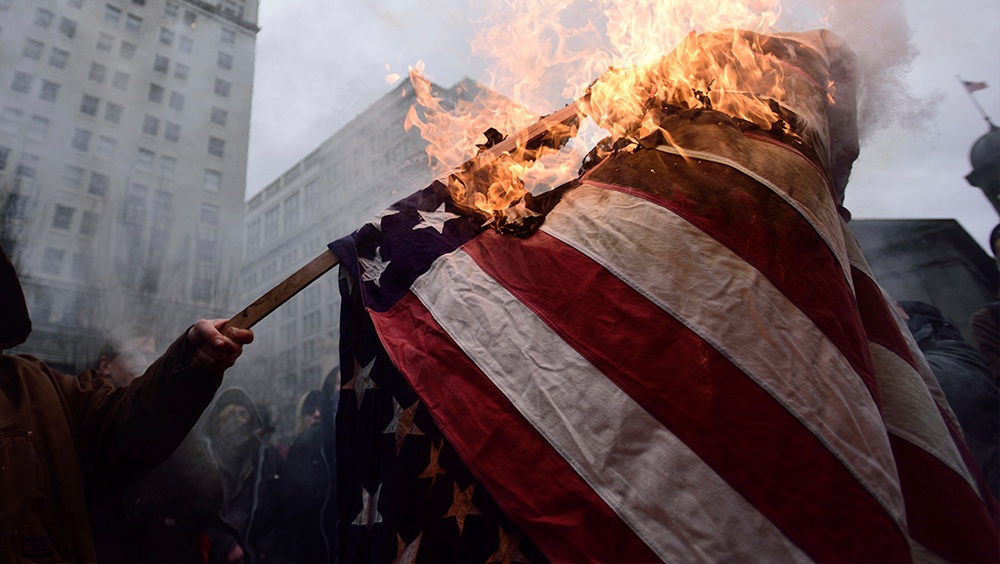
The President quietly signed yet another executive order on Monday. Citizens who choose to burn the American flag during protests are no longer merely exercising protected political expression. The First Amendment has been downgraded to a charming suggestion. Federal prosecutors now have the green light to pursue criminal charges—almost as if the Constitution were negotiable.
Under this order, Attorney General Pam Bondi is instructed to comb through instances of flag burning and determine whether they also constitute crimes such as disturbing the peace or breaking environmental laws. “If you burn a flag, you get one year in jail,” the President confidently remarked while signing the document—though notably, the order itself carefully avoids spelling out that exact sentence.
It appears that attempting to maneuver around a 1989 Supreme Court ruling was the plan all along. In Texas v. Johnson (1989), the Court decided, 5–4, that flag burning is protected political expression under the First Amendment. The decision invalidated flag-burning laws in 48 states almost immediately and reaffirmed that government cannot prohibit an idea simply because society finds it offensive. Justice Scalia—who joined the majority—is cited by legal scholars as someone who opposed flag desecration personally, yet vigorously defended the constitutional right to perform it.
Trump’s order doesn’t mention jail time directly, but he did make the statement in the Oval Office, and the Justice Department is now tasked with treating flag-burning incidents as potentially criminal—even if they overlap with other federal offenses such as property damage or incitement to imminent violence. Legal experts promptly criticized the move as bordering on unconstitutional overreach.
Polling data suggests that public opinion may be catching up to executive preference. A YouGov poll from 2020 found that about half of Americans think flag desecration should be illegal, while one-third hold that it should remain legal. More recently, in September 2023, another YouGov survey reported that 59% of Americans consider burning an American flag during protests “always unacceptable”.
Thus, the order might be less about constitutional law, and more about alignment with majority sentiment—or at least the majority who respond to polls.
The Executive Branch, in short, has decided that before the First Amendment can ruin your day with inconvenient rights, a prosecutor should step in. Citizens now face the novel burden of verifying whether their protest includes felony —and ensuring they don’t upset the government too much while making their political point.