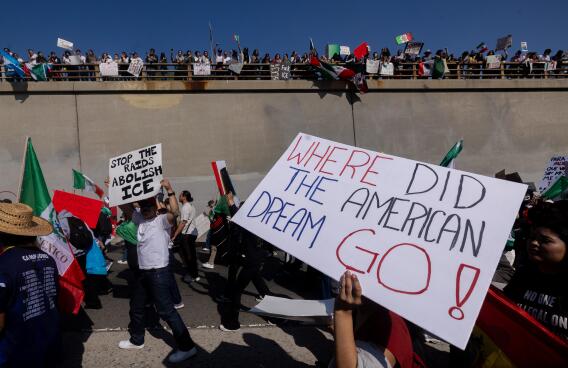
LOS ANGELES — Saturday’s anti-ICE protest at MacArthur Park drew thousands of demonstrators, multiple handmade signs, and banned social media coverage. The confusion was understandable: in order to avoid being shadow-banned, TikTok users were referring to the gathering not as a “protest,” but as a “music festival,” “community picnic,” or, in one case, “a bunch of people standing near a Home Depot for absolutely no reason.”
Organizers marched from MacArthur Park to a nearby Home Depot, condemning recent immigration raids that advocates say have turned the store’s parking lots into convenient pickup zones for federal enforcement. Activists delivered speeches about immigrant rights, housing insecurity, and police accountability—but on TikTok, those moments were tagged under hashtags like #SummerJamLA, #BlockPartyForJustice, and the increasingly popular #NotAProtestDontBanMe.
According to multiple TikTok creators, using the actual word “protest” in captions or hashtags triggered an immediate drop in reach, with videos disappearing from search results entirely. One attendee, who posted under the alias “Protest? I Don’t Know Her,” said her footage was removed within minutes: “The second I wrote the P-word, it was like TikTok sent my video into the cornfield.”
As a result, the digital coverage of the August 9 rally took on the aesthetic of a neighborhood festival—complete with captions about “live performances” (activists on megaphones) and “crowd participation games” (call-and-response chants about abolishing ICE). The workaround wasn’t foolproof; several creators reported that even euphemisms like “march” and “rally” were being quietly throttled. “By next week,” one TikTok user warned, “we’ll have to call it a ‘silent interpretive dance about policy reform.’”
Mainstream media’s contribution to the blackout was even simpler: they largely didn’t show up. While NBC Los Angeles and City News Service provided basic reporting, the coverage was buried beneath lighter stories, like a squirrel rescue in Burbank. Cable news ignored the event entirely, leaving the impression that the protest had occurred in a vacuum—perhaps in an alternate reality where free speech exists only if it can be monetized.
Ironically, the censorship became part of the protest’s message. Speakers at MacArthur Park warned that suppression—whether through corporate algorithms or editorial disinterest—was itself a form of political control. “When you can’t say you’re protesting ICE raids without the internet pretending you don’t exist,” one organizer said, “that’s not just censorship, that’s marketing for authoritarianism.”
The protest ended peacefully, with no reported arrests, arrests of the narrative notwithstanding. Videos from the event remain scattered across TikTok under obscure tags, sandwiched between actual music festival clips and unrelated K-pop fan edits.
And in a twist that would make any pro-Republican strategist proud, the protest’s message—urgent, emotional, and rooted in civil rights—was delivered to the exact number of people algorithms deemed safe: essentially none.