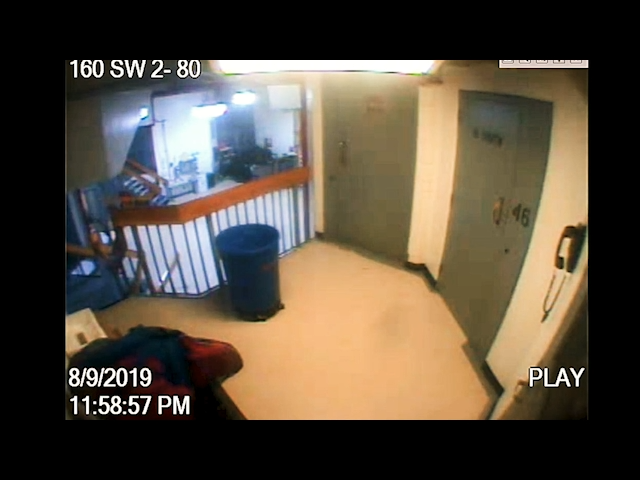
WASHINGTON, D.C. — In a sweeping reaffirmation of the federal government's commitment to slightly edited truth, officials have clarified that the controversial “missing minute” from surveillance footage the night of Jeffrey Epstein’s death wasn’t missing—it was just, in their words, “temporarily displaced for national consistency.”
The Department of Justice, working in close cooperation with the FBI and the Bureau of Prisons, has confirmed that what appeared to be a one-minute gap in the surveillance video released earlier this month was, in fact, part of a longstanding and highly sophisticated video preservation protocol known internally as “Nightly Reset.”
“This is how high-level federal surveillance systems have operated for decades,” said former Florida Attorney General Pam Bondi during a recent Cabinet meeting. “Every night, the system resets for exactly one minute to prevent over-surveilling inmates, which we now understand could constitute cruel and unusual documentation.”
Bondi added that the security system—last updated around the same time Fight Club was in theaters—was “a marvel of turn-of-the-century technology” and prone to nostalgic design features like analog clocks, VHS formatting, and periodic self-deletion. “The Bureau of Prisons assures us this is entirely normal,” she said. “Like a grandfather clock, if that clock lost a minute every night and was also involved in one of the most high-profile deaths of the decade.”
Though no supporting footage has yet been released to demonstrate that this “missing minute” occurs nightly, DOJ officials say it will be provided “eventually or hypothetically,” pending confirmation from “relevant authorities within the government or possibly outside of it.”
Video forensic experts, meanwhile, have raised entirely irrelevant technical questions. “What we saw was not raw footage,” said Jim Stafford, an analyst consulted by CBS News. “The file was created in May, it was a screen capture, and the metadata shows the video was actually two separate clips, edited together and slightly sped up.”
To the DOJ, such findings are unimportant. “What matters here is not how the video was created, or when, or by whom,” said FBI Deputy Director Dan Bongino, who appeared visibly relaxed during a Monday press briefing. “What matters is that it supports the official conclusion that Epstein died by suicide and that absolutely nothing unusual happened in the federal facility that temporarily ‘lost’ the cameras outside his cell, his cellmate, and now—apparently—time itself.”
Pressed on why a video marketed as “full raw” appears to have been stitched together and speed-adjusted, DOJ spokesperson Meredith White responded, “Raw is a relative term. In government parlance, ‘raw’ can also mean ‘briefly processed, gently curated, and mostly there.’”
Critics and conspiracy theorists continue to question the events of August 9-10, 2019, but officials say this skepticism only underscores the public’s lack of familiarity with routine government procedures.
“It’s not a cover-up,” said White. “It’s simply a case of America not appreciating the subtle art of selective transparency. We gave you almost everything.”
When asked if the FBI would commit to releasing the complete unedited footage, White nodded solemnly. “Absolutely. Once it has been thoroughly verified, compressed, trimmed, denoised, and formatted for public peace of mind.”
As for whether Epstein’s death will be reinvestigated, sources inside the Bureau of Prisons say there are “no plans to question any conclusions reached by agencies who self-reviewed their own handling of the matter.”
“The system works,” said Bondi. “Even when it glitches. Especially when it glitches.”