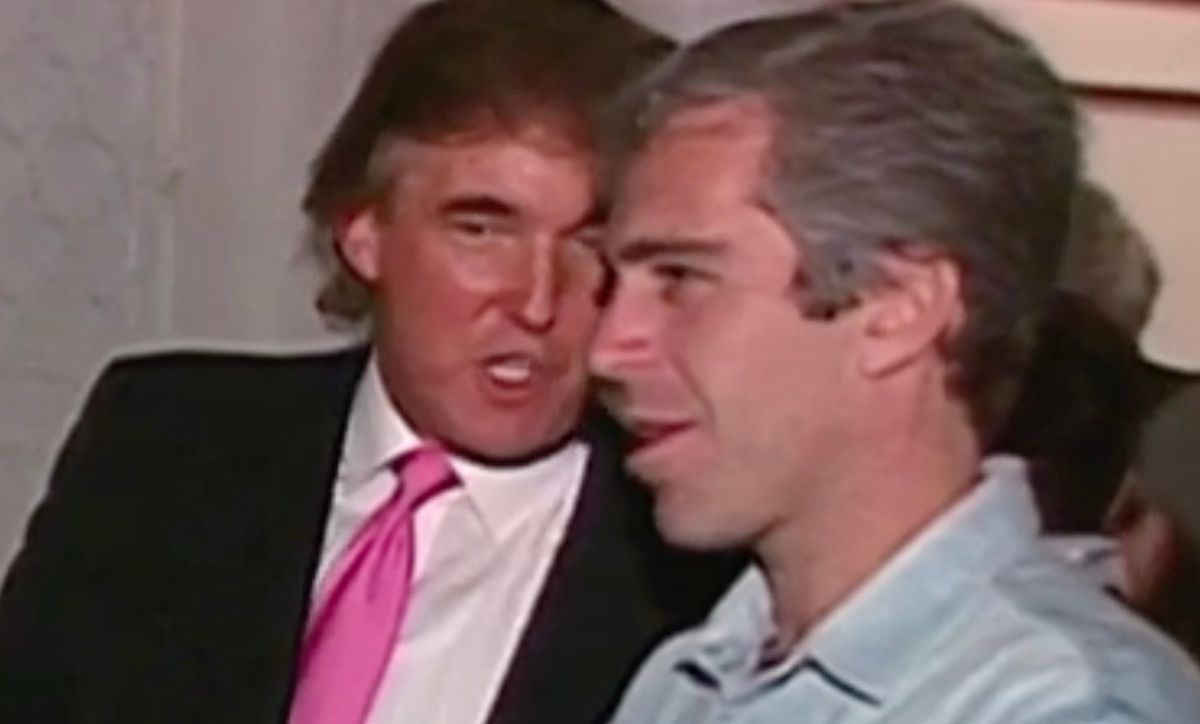
PALM BEACH, FL — President Donald J. Trump claimed this week that disgraced financier Jeffrey Epstein “stole” a teenage staffer from Mar-a-Lago in what he implied was an underhanded recruitment maneuver.
“He took her,” Trump says flatly. “She worked for us. He stole her. That’s when I knew we had a problem.”
According to Trump, the staffer in question—later identified publicly as Virginia Giuffre—was poached from what the former president refers to as “our program,” sparking what he now frames as a years-long cold war between two men vying for dominance in what appears to be an unspoken scouting circuit for young women.
While Trump did not mention Giuffre by name, his comments suggest that the rift between him and Epstein was less about principle and more about poaching. “He broke the code,” Trump said. “There’s a way you build a team. He didn’t respect that.”
Supporters quickly took to social media to praise the former president’s leadership, describing him as a man who “walked away from the game when it got dirty,” despite appearing to have participated in the same league for several seasons. One Truth Social user called the clip “proof that Trump played clean while the other side cheated,” adding, “That’s the difference between a dynasty and a scandal.”
Critics, however, pointed out that the casual framing of what is widely recognized as a human trafficking operation seemed to treat the exploitation of teenage girls more like a front-office dispute than a federal crime. “He’s describing child sex trafficking like it’s college football recruiting,” said one former federal prosecutor. “If this were satire, it’d be brilliant. But it’s not.”
Trump’s defenders argue that the video actually strengthens his moral standing. “What you’re seeing is a man who recognized Epstein’s tactics and disapproved,” said former White House strategist Steve Bannon. “He saw the corruption and refused to play ball.”
Still, questions remain about why Trump, who had previously spoken positively of Epstein—calling him “a lot of fun to be with” and praising his taste in “younger women”—did not disclose this alleged breach of protocol during any of the many public inquiries into their relationship.
“Sometimes you keep rivalries close to the chest,” said a source familiar with Trump’s inner circle. “You don’t always air that stuff unless you’re forced to. But make no mistake: it was personal. Like Belichick and the Jets.”
Pressed by reporters about the timeline, Trump clarified that his fallout with Epstein occurred sometime “around 2000,” coinciding with the staffer’s departure from Mar-a-Lago. Yet no public statement, legal action, or distancing occurred at the time, prompting critics to ask whether the feud was real—or simply being retrofitted as damage control now that the tapes are out.
Even so, the narrative has legs among the base.
“This just proves Trump isn’t like them,” said Fox News contributor Jesse Watters. “He got burned by Epstein. He got out-recruited. That’s why he distanced himself. That’s what good coaches do—they cut players and walk away from dirty deals.”
As for the Epstein camp, there are no comments forthcoming—owing, of course, to the fact that Epstein died in federal custody in 2019 under circumstances the FBI continues to describe as a suicide, though with footage missing, guards asleep, and cellmates reassigned. The recruitment board, it seems, was wiped clean.
In the end, Trump’s comments offer a new lens through which to view the scandal—as a competitive dispute between two titans of influence playing by their own rules, in a league only they seemed to understand.